RV AC Repair: What’s Usually Wrong, What to Check, and Costs
By Gus Amundsen · October 19, 2026
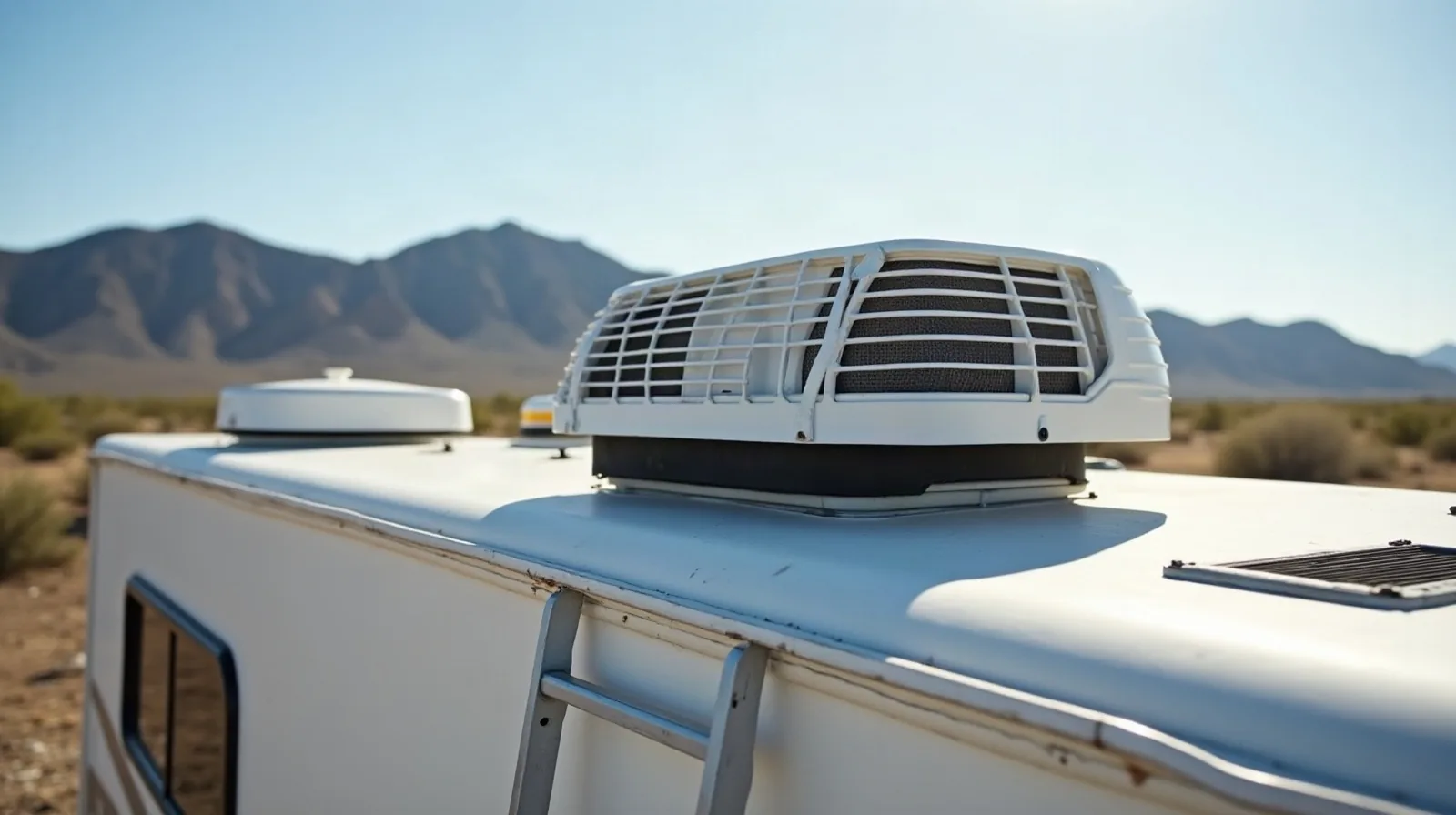
It was 108 degrees on a July afternoon outside Las Vegas, and my fifth wheel’s front AC picked that moment to hum and quit, which is why I know a few good RV AC repair techs in Las Vegas. I’d been on the roof ten minutes earlier, coil brush in hand, but the capacitor didn’t care. Twenty years of residential HVAC taught me to start with the simple stuff, so I climbed back up, pulled the shroud, and forty minutes later I was cooling again for less than what I’d paid for lunch. That’s the thing about RV AC repair: most failures are small, cheap and fixable with a multimeter and some patience, and the same logic carries over to RV furnace repair when the blower runs but there’s no heat.
The trick is knowing what’s usually wrong before you start throwing parts at it. If you’d rather have a pro handle it, look up RV AC repair techs in Las Vegas or a shop near you and ask what they charge to diagnose.
First check: the temperature drop tells you a lot
A healthy rooftop AC shoudl blow air about 15 to 20 degrees F colder than the air it’s pulling in, and that measurement tells you whether you even have a problem worth chasing. I measure it with two cheap thermometer probes, one in the return grille and one in the closest ceiling vent. If I see less than 15 degrees, I go looking for reasons. It works the same as a residential split system, except everything’s crammed into one box on the roof. You need good airflow across both coils.
What you can check: pull the filter every few weeks when you’re running the AC hard. If the airflow feels weak even with a clean filter, suspect a dirty evaporator coil or a worn blower motor.
The hum but no start: it’s usually the capacitor
When my front AC quit outside Vegas, it made exactly one sound: a low hum for a few seconds, then silence. Classic capacitor failure.
Safety warning: shut off shore power, the generator and the inverter first, and remember capacitors store a dangerous charge even with the power off. Discharge it with an insulated tool or a bleed resistor before you touch a terminal, or let a tech do it. The part itself is cheap, about $15 to $50. How to test it: you can’t always tell by looking. If the fan runs but the compressor doesn’t, it could still be the capacitor, or it could be a failing compressor. That’s when you need a tech with a capacitor tester and an amp clamp. RV AC repair shops and mobile techs nationwide can diagnose it properly.
Frozen coil? It’s almost always airflow, not refrigerant
I get calls from RV owners who say their AC ices up or stops cooling and drips water from the ceiling. It’s not low on refrigerant. A frozen evaporator coil almost always means poor airflow across the coil. Fix the airflow first: clean or replace the filter, check that all vents are open, and clean the evaporator coil if you can reach it. I’ve fixed half a dozen frozen coils just by replacing a dirty filter that looked clean from the passenger seat. Low voltage from a weak shore power pedestal can also cause poor cooling and occasional freezing.
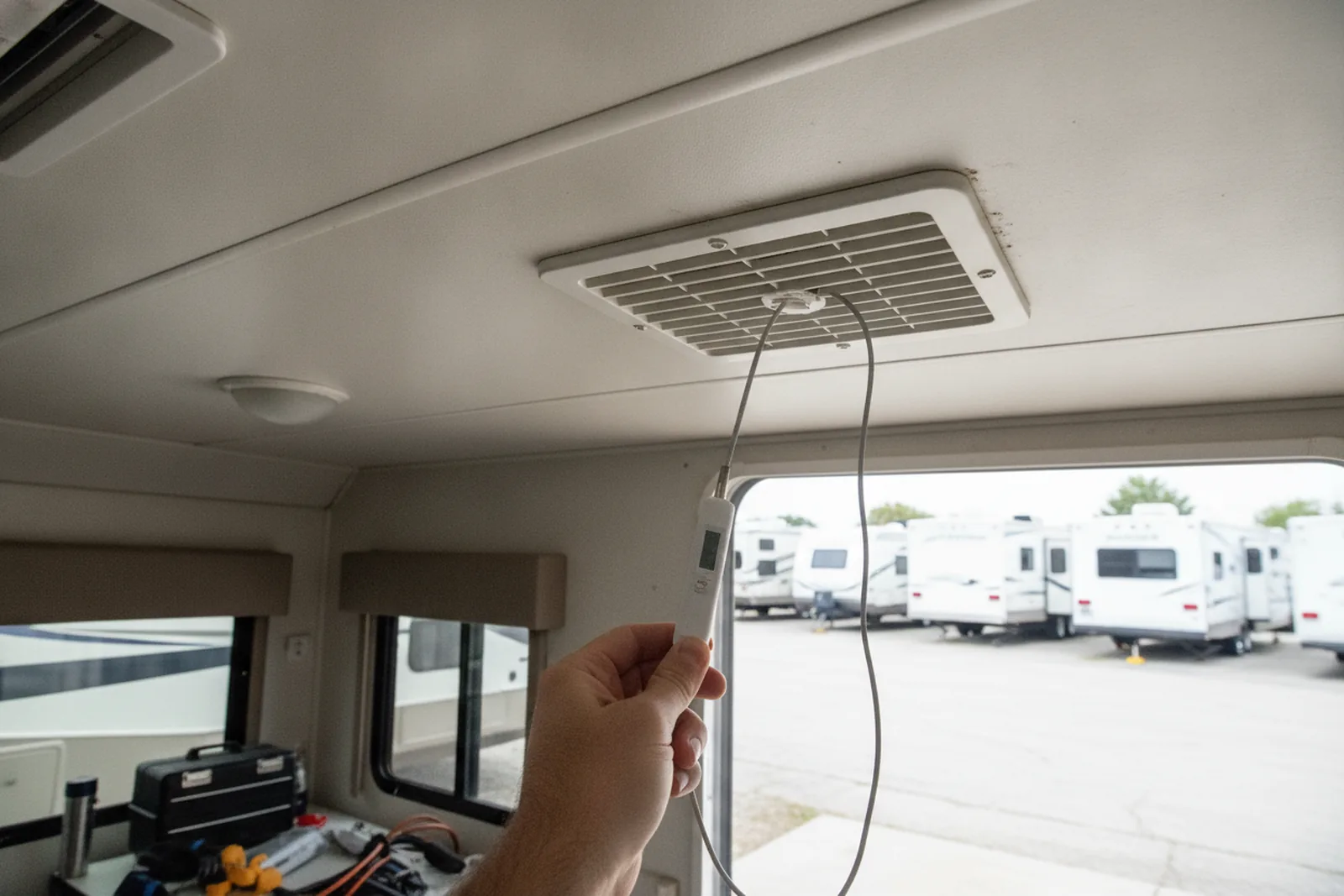
I found a video that walks through testing an RV air conditioner that isn’t cooling, and it’s worth a watch before you call a tech.
When the fan motor dies: diagnosis and cost
A rooftop AC has one or two fan motors, and the good news is most motor failures announce themselves before they leave you hot. I always check the motor bearings first. If the motor is done, a new one runs about $100 to $250 for the part. Just make sure you get the right rotation direction and the same shaft lenght.
If the fan runs but makes a terrible squealing or rattling, that’s usually a bad bearing or a bent blade. Turn it off and inspect. A bent blade can be gently straightened, but a bad bearing means a new motor. I once replaced a fan motor in a customer’s trailer becuase the blade had hit a tree branch on a mountain road and wobbled itself to death. It sounded like a coffee grinder.
Check the roof gasket while you’re up there. Loose mounting bolts or a cracked gasket can let water in around the AC, which leads to ceiling sag and rot. I tightened the four bolts on my own unit last spring and stopped a small leak before it got ugly.
Electrical gremlins: thermostats, boards, and low voltage
If the AC doesn’t respond to the thermostat at all, or it runs but cycles oddly, suspect the thermostat or the control board. I start with the easy stuff: check the thermostat batteries, check the 12-volt fuse, and verify the thermostat is getting power.
Low shore power voltage is a sneaky problem. A good surge protector with a low-voltage cutoff will shut things down before damage. I plug into one every time, and I recommend you do the same.
On 30-amp service, a 13,500 BTU AC pulls 11 to 13 amps running, and start surge can spike to 30 amps or more. Add the converter, the fridge on electric, and a few other loads, and you’re at the edge. A soft-start device ($150 to $300 as a part, $250 to $400 installed) tames that surge and lets the AC run on a smaller generator or a weak pedestal. I installed one on my front unit after a couple of nuisance breaker trips.
Sealed system: no recharging, usually replacement
Unlike your car, a rooftop RV AC has no service ports. A new rooftop AC runs about $700 to $1,500 for the part, and $1,200 to $2,500 installed.
How do you know if the sealed system is bad? Symptoms include warm air, ice on the suction line, or the compressor cycling on and off rapidly. A tech will check pressures with a piercing valve, but once the system is opened, its done. I tell owners to budget for a new unit if the compressor is toast.
While the old unit is off, inspect the roof opening and the gasket. A crushed or cracked gasket is a common source of leaks, and a sagging ceiling around the AC often means the mounting bolts are loose or the gasket has failed. Use the manufacturer’s torque spec when re-tightening, not guesswork.
Shop or mobile tech for RV AC repair? And what you’ll pay
Most RV AC work can be done by a mobile tech in your driveway or campsite, and that’s usually the cheapest way to get it done right the first time. Shops charge $100 to $200 an hour, with a diagnostic fee of $100 to $200 that’s often credited toward the repair.
Here’s a quick breakdown:
| Repair job | Typical DIY part cost | Typical shop cost all-in |
|---|---|---|
| Capacitor replacement | $15–$50 | $100–$250 |
| Fan motor replacement | $100–$250 | $250–$450 |
| Thermostat replacement | $50–$150 | $150–$300 |
| Control board replacement | $50–$250 | $200–$400 |
| Soft-start install | $150–$300 | $250–$400 |
| Rooftop unit replacement | $700–$1,500 | $1,200–$2,500 |
I’ve always found mobile techs easier for AC work. They come to you, they carry the common parts, and they don’t make you sit in a waiting room. Ask about thier certification, insurance, and warranty on parts and labor. A good tech will explain what they’re doing and show you the old part.
If your AC fails while boondocking and you’re also fighting a generator that won’t start, check out our post on RV generator repair. The two problems often happen at the same time, and the fix for one might help the other.
My honest take after twenty years of fixing ACs
Here’s what I’d tell any RV owner: buy a cheap multimeter, learn to test a capacitor, and clean your coils twice a year.
If you’d rather not climb on the roof, that’s fine. Pull up RV AC repair shops and mobile techs nationwide and ask two of them for a written estimate on your specific symptom.
This weekend, take a thermometer to your nearest vent when the AC has been running for ten minutes. If it’s not 15 to 20 degrees colder than the return, you have work to do. And if it is, keep the filter clean and wait for the next 108-degree day. It’ll come.
More from the shop floor
FAQ
How much does it cost to repair an RV air conditioner?
It depends on the part. A simple capacitor replacement typically runs $100 to $250 at a shop, a fan motor $250 to $450 installed, and a thermostat $150 to $300. If the sealed system has failed, a new rooftop unit runs about $1,200 to $2,500 installed. Mobile techs charge a trip fee of $75 to $200 plus $100 to $175 an hour.
Why does my RV AC freeze up?
Almost always poor airflow. A dirty filter, clogged evaporator coil, closed vents, or a slow fan motor causes the coil to get too cold and ice up. Turn the AC off, let it thaw, clean or replace the filter, and check the vents. If it freezes again, suspect the fan motor or a low voltage condition.
Can I recharge my RV air conditioner myself?
No. Rooftop RV ACs are sealed systems with no service ports. Most are not designed to be recharged. If the refrigerant leaks out, the unit usually needs to be replaced. It's not like a car AC where you can add a can of refrigerant.
How do I know if my RV AC capacitor is bad?
The classic symptom is a hum for a few seconds when you turn on the AC, then silence. The compressor or fan can't start. You can test the capacitor with a multimeter that has a capacitance setting, but if it matches the symptoms and looks bulged or leaking, it's probably bad. Always discharge it safely before touching.
Why does my RV AC trip the breaker on 30-amp service?
A 13,500 BTU AC draws 11 to 13 amps running, but the start surge can spike much higher. Combined with other loads like the converter or fridge on electric, it can trip a 30-amp breaker. Install a soft-start device to reduce the surge, or run less appliances at once.
How often should I clean my RV AC filter?
Every two to four weeks when you're using the AC heavily. A dirty filter is the number one cause of poor cooling and frozen coils. It's a five-minute job: remove the filter, wash it with mild soap and water, let it dry, and put it back. Check the owner's manual for your specific model.
Find RV repair near you
Compare RV service centers and mobile techs in your city, then ask a few for a quote on the job.
Browse by state